DACx – Digital Auditory Cortex
DACx is an R/C++ package for running biologically realistic simulations of the mammalian auditory cortex – a “digital twin”. Network topologies are built from clusters of cells, called nodes, arrayed in three dimensions and connected using circuit motifs. Network activity is simulated using an expanded version of the growth-transform (GT) membrane voltage time derivative introduced by Gangopadhyay and Chakrabartty.
The package is built around several C++ object classes for building networks:
cell_type: Astrucfor specifying cell characteristics related to membrane electrical properties and kinetics, axon transmission speed, synaptic transmission, and axon and dendrite arborization.cell_arbors: Astrucfor efficiently storing and manipulating large branching tree structures representing axonal and dendritic arbors.motif: Aclassfor specifying general patterns of connectivity between cells in a circuit, relative to an indexical pre-synaptic home column.network: Aclassfor simulating spiking neural networks with GT dynamical systems.
Networks are built using motifs, which ultimately specify a matrix of transconductances (synaptic weights) between cells. The raison d’être of networks is to compute signal transmission lag between cells from their types and arbors and to compute the resulting network state from the GT membrane voltage time derivative .
What is the “growth-transform” ? The net metabolic power used by a spiking neural network can be thought of as a cost function and the network itself can be thought of as a mathematical manifold of membrane voltage values, one per cell. Gangopadhyay and Chakrabartty have shown how to apply the Baum-Eagon inequality to on to derive a function that is guaranteed to monotonically decrease over time. Such a function is called a growth transform. Although this derivation of is purely mathematical without any reference to the biological phenomenon being modeled, the introductory tutorial to spatial growth-transform models provides a biologically interpreted and motivated derivation.
GitHub: https://github.com/Oviedo-Lab/DACx
Documentation: https://oviedolab.org/DACx/
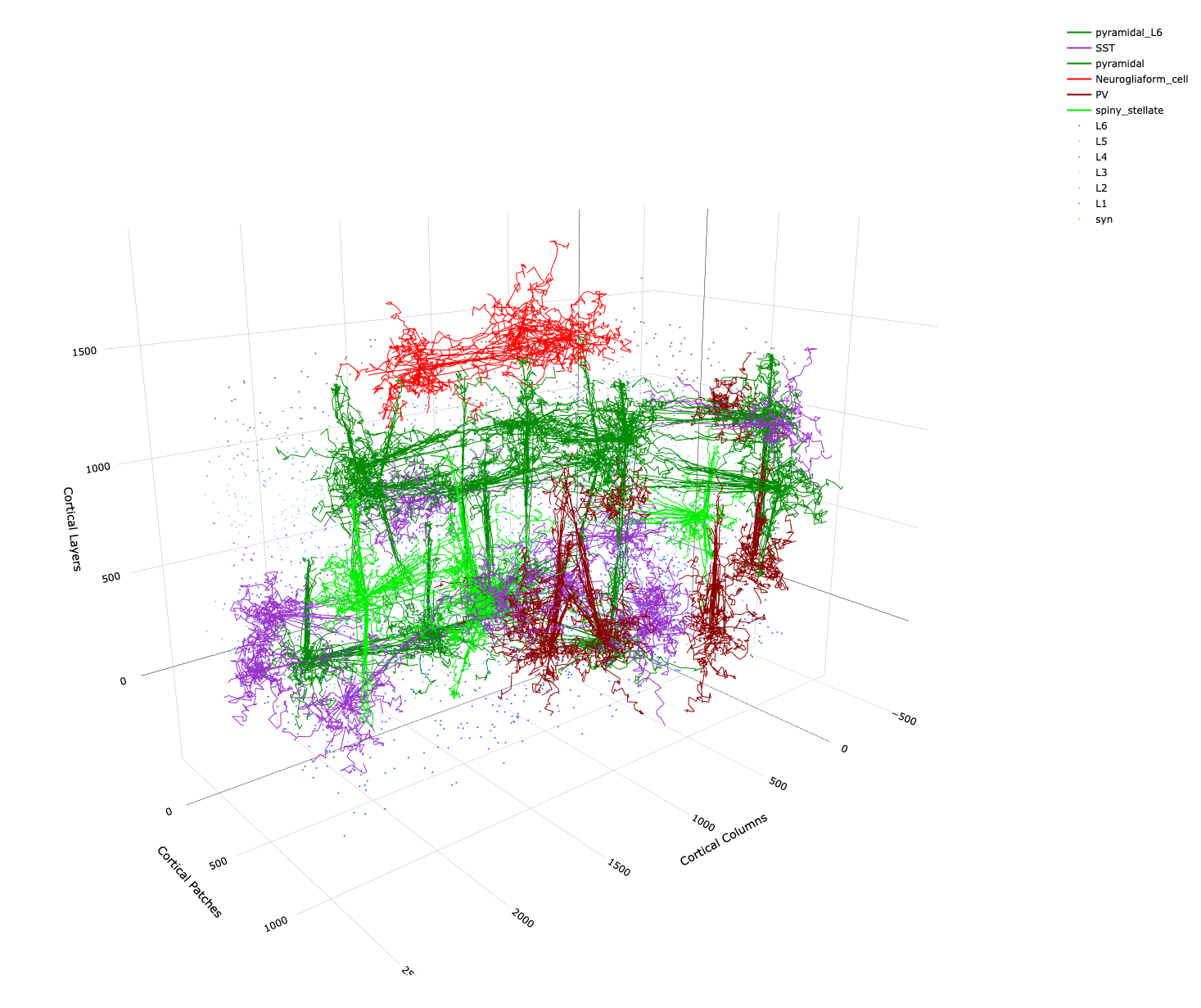
Example plot of 3D network topology producable with DACx.
Who we are
DACx is a collaboration between Oviedo Lab (Neuroscience) and the AIM Lab (Electrical & Systems Engineering) at Washington University in St. Louis.
Copyright © 2026, Michael Barkasi
barkasi@wustl.edu