Spatial growth-transform models
Michael Barkasi
August 15, 2026 (v1.1)
tutorial_SGT.RmdIntroduction
The simplest mathematical models of neural networks are built from homogeneous McCulloch-Pitts neurons with atemporal, scalar-weight connections between them. Biological neural networks, such as those in the mammalian brain, are far more complex. They contain different types of neurons each with their own electrical behavior and spatiotemporally extended connections.
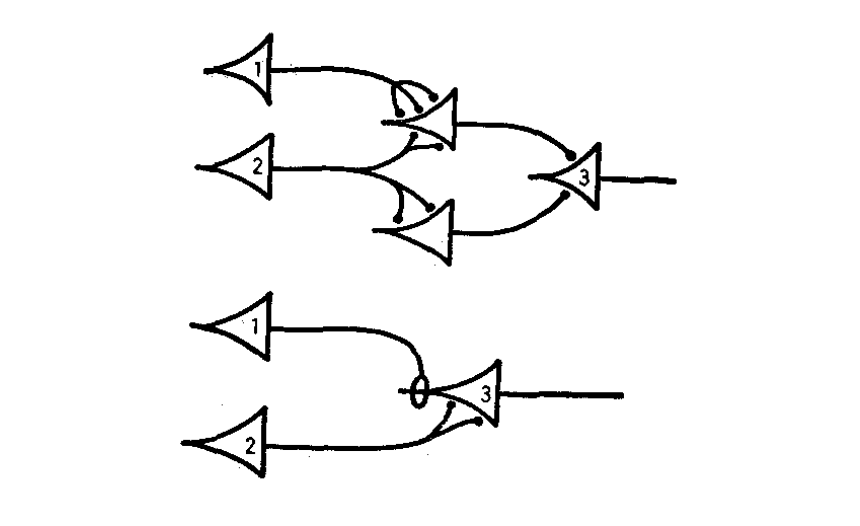
A sample neural network diagram from the original 1943 paper by McCulloch and Pitts.
Computational neuroscientists standardly model biological neural networks as dynamical systems, i.e., as having time-dependent states. Growth-transform (GT) models, extended to spiking neural networks by Gangopadhyay and Chakrabartty, are one example. These models treat the change in membrane potential over time, \partial v/\partial t, as a growth-transform of the membrane potentials v on the net metabolic power \mathcal{H} of a network, in the sense that it’s assumed that \partial v/\partial t satisfies the Baum-Eagon inequality: \mathcal{H}(v)\leq \mathcal{H}(v + \partial v/\partial t) In other words: \frac{\partial\mathcal{H}}{\partial v}\frac{\partial v}{\partial t} \leq 0 Thus, GT models are essentially energy-minimization models of neural dynamics. This is in contrast to models such as Hodgkin-Huxley, which describe neural dynamics directly in terms of ionic currents. Despite this apparent disconnect from biology, DACx is based on a biological interpretation of the underlying mathematics of GT models.
In practical terms, instead of only a weight between two homogeneous neurons, GT models use both a cell-type-dependent synaptic conductance parameter and a cell-type-dependent temporal modulation factor to determine network behavior. The synaptic conductance parameter is essentially a traditional connection weight, while the temporal modulation factor allows for capturing the electrodynamics \partial v/\partial t of different neuron types at a single spatial point.
The GT models implemented in the DACx package add a third aspect of biological realism not captured by the original formulation of Gangopadhyay and Chakrabartty: a transmission velocity parameter for each neuron type. While the temporal modulation factor controls membrane voltage over time at a single spatial point, the transmission velocity parameter determines the rate at which changes in membrane voltage propagate between neurons. For this reason, we refer to our GT models as spatial GT (SGT) models.
SGT models thus allow for network topologies that not only capture connection strengths between neurons, but also the different types of neurons and their electrodynamics across both time and space. A separate tutorial demonstrates how to build spatially extended network topologies for these models from circuit motifs. This tutorial explains SGT models in more detail.
Network nodes
Let’s set up the R environment by clearing the workspace, setting a random-number generator seed, and loading the DACx package.
# Clear the R workspace to start fresh
rm(list = ls())

# Set seed for reproducibility
set.seed(12345)

# Load DACx package
library(DACx, quietly = TRUE)
Next, we create a new network object with the new.network function.
network.node <- new.network()The object initialized by new.network is a single-node network. As we use the term, a “node” is not necessarily a single neuron, but is rather a cluster of nearby neurons with local recurrent connections. These nodes are expected to be (approximately, locally) fully connected, with cells of each type synapsing into cells of all other types, at least for nearby cells. For this tutorial, our nodes will include two distinct neuron types: an excitatory type, loosely based on layer 4 principal neurons (spiny stellates), and an inhibitory type, loosely based on parvalbumin (PV) interneurons. We’ll call them “spiny stellate” and “PV” cells, to indicate that the simulated spiny stellates have a lower tau_fast than expected, and that the simulated PV cells have a lower g_leak than expected.
Nodes are defined by their constitutive cell types and node size (i.e., expected number of neurons per type). DACx comes with a number of preloaded cell types and functions for modifying existing cell types and adding new ones. Details about cell types are discussed in another tutorial. We will use the modify.cell.type function to set up our spiny stellate and PV cells. We start by explicitly setting all values in a generic template type, even those that aren’t changed from the defaults for spiny stellates and PV cells, for later reproducibility.1 The details of these parameters are explained in the tutorial on cell types.
modify.cell.type(
    "neuron",
    # Membrane kinetics
    tau_fast              = 2.5,   # ms
    tau_slow              = 60.0,  # ms
    tau_Vs                = 100.0, # ms/spike
    dCdr                  = 0.01,  # concentration/spike
    dVdr                  = 0.05,  # concentration/spike
    max_spike_rate        = 0.1,   # spikes/ms
    g_leak                = 5.0,   # nS
    # Intercell transmission
    spike_velocity        = 500,   # micons/ms, = 0.5 m/s
    spine_density         = 0.0,
    axon_target           = "dendrite_shaft",
    # Spiking
    I_spike               = 1e3,   # pA
    dHdv_bound            = 1.05,
    v_spike               = 35,    # mV
    tau_spike             = 1.0,   # ms
    v_threshold           = -55,   # mV
    v_eq                  = list ( # mV
      "spiny stellate" = 0.0,    # Excitatory, so drives postsynaptic cell membrane v up
      "PV"             = -80.0), # Inhibitory, so drives postsynaptic cell membrane v down
    # Membrane characteristics
    v_rest                = -70,   # mV
    v_bound               = 1.15,
    g_syn                 = list(  # nS
      "spiny stellate" = 0.1,
      "PV"             = 0.1),
    tau_syn               = list(  # ms
      "spiny stellate" = 2.0,   # Excitatory glutamate channels close quickly
      "PV"             = 6.0),  # Inhibitory GABA channels stay open longer
    # Neurite structure
    axon_branch_count     = 20,
    dendrite_branch_count = 20,
    branch_independence   = 0.75,
    branch_spread         = 0.75,
    apical_target_layer   = "none"
  )
For now, it suffices to note that PV interneurons are highly responsive cells with a high rate of fire, little adaptation (i.e., little short-term depression), but also little memory – that is, they have a high leak current and don’t integrate signals. Thus, they function as coincidence detectors (integrating only near-simultaneous input spikes) and send strong inhibitory signals. We will keep that character, except for giving them a lower leak conductance to improve their memory.
modify.cell.type(
    "neuron",
    "PV",
    # Membrane kinetics
    tau_fast       = 1.0,   # ms, Short for fast responses
    tau_Vs         = 2.5,   # ms/spike, Fast recovery for little adaptation
    dVdr           = 0.025, # concentration/spike, Low vesicle rate for fast spiking
    max_spike_rate = 0.5,   # spikes/ms, High max spike rate
    g_leak         = 10.0,  # nS, Hight leak conductance for fast kinetics
    # Spiking
    I_spike        = 2e3,   # pA, High-current spikes
    tau_spike      = 0.3,   # ms, Short-duration spikes
    v_threshold    = -50,   # mV, Slightly higher threshold
    spine_density  = 0.0,
    axon_target    = "soma",
    # Set synaptic weights
    g_syn          = list(  # nS
      "spiny stellate" = 2.0,
      "PV"             = 1.0)
  )
Conversely, spiny stellate cells are slower to respond, have higher adaptation, but more memory. They serve as signal integrators, integrating input spikes over longer time stretches. We keep that character, except for lowering their fast-current time constant (tau_fast) to make them more responsive.
modify.cell.type(
    "neuron",
    "spiny stellate",
    # Membrane kinetics
    tau_fast       = 5.0,   # ms, Long for slow responses responses
    g_leak         = 1.0,   # nS, Low conductance for slow kinetics
    # Intercell transmission
    spike_velocity = 100,   # microns/ms, slower transmission than PV cells
    spine_density  = 0.5,
    axon_target    = "spine",
    # Membrane characteristics
    g_syn          = list(  # nS
      "spiny stellate" = 0.4,
      "PV"             = 4.0)
  )
Notice that defining the cell types involves setting a g_syn, taking a list which each cell type as a named entry. This conductance gives the conductance (in nS) of the cell type’s synapses, for each pre-synaptic cell type. So, the above settings imply that PV connections onto spiny stellates are much stronger than connections from other spiny stellates, while spiny stellates have much stronger projections onto PV cells than PV cells have onto other PV cells. These values are not strictly faithful to the actual biology, but will be suitable for modeling a simple excitatory-inhibitory feedback system.
Mimicking the structure of the brain, nodes are arrayed into layers and columns, cortical and subcortical regions, and hemispheres. The network-topology tutorial explains how to set up this multi-node structure. For now, it suffices to note that this structure is set with the set.network.structure function. We will set up a single-node network, with an expected count of 50 for the spiny stellates and 5 for the PV interneurons.
n_ss <- 50
n_PV <- 5
sn   <- 20
network.node <- set.network.structure(
    network.node,
    neuron_types          = c("spiny stellate", "PV"),
    neurons_per_node      = c(n_ss, n_PV),
    synaptic_neighborhood = sn # microns
  )
By default, the set.network.structure function creates no subcortical layers and sets the number of cortical layers, columns, patches (a secondary columnar axis perpendicular to the laminar axis), and hemispheres each to one. That is, it makes a single node. It also initializes local recurrent connections within that node. The node we just created can be visualized with the plot.network function. To keep the plot clean, we can use the arbor_density argument, which controls the proportion of cells for which the generated arbors are shown.
plt <- plot.network(network.node, arbor_density = 0.1)
plt$plot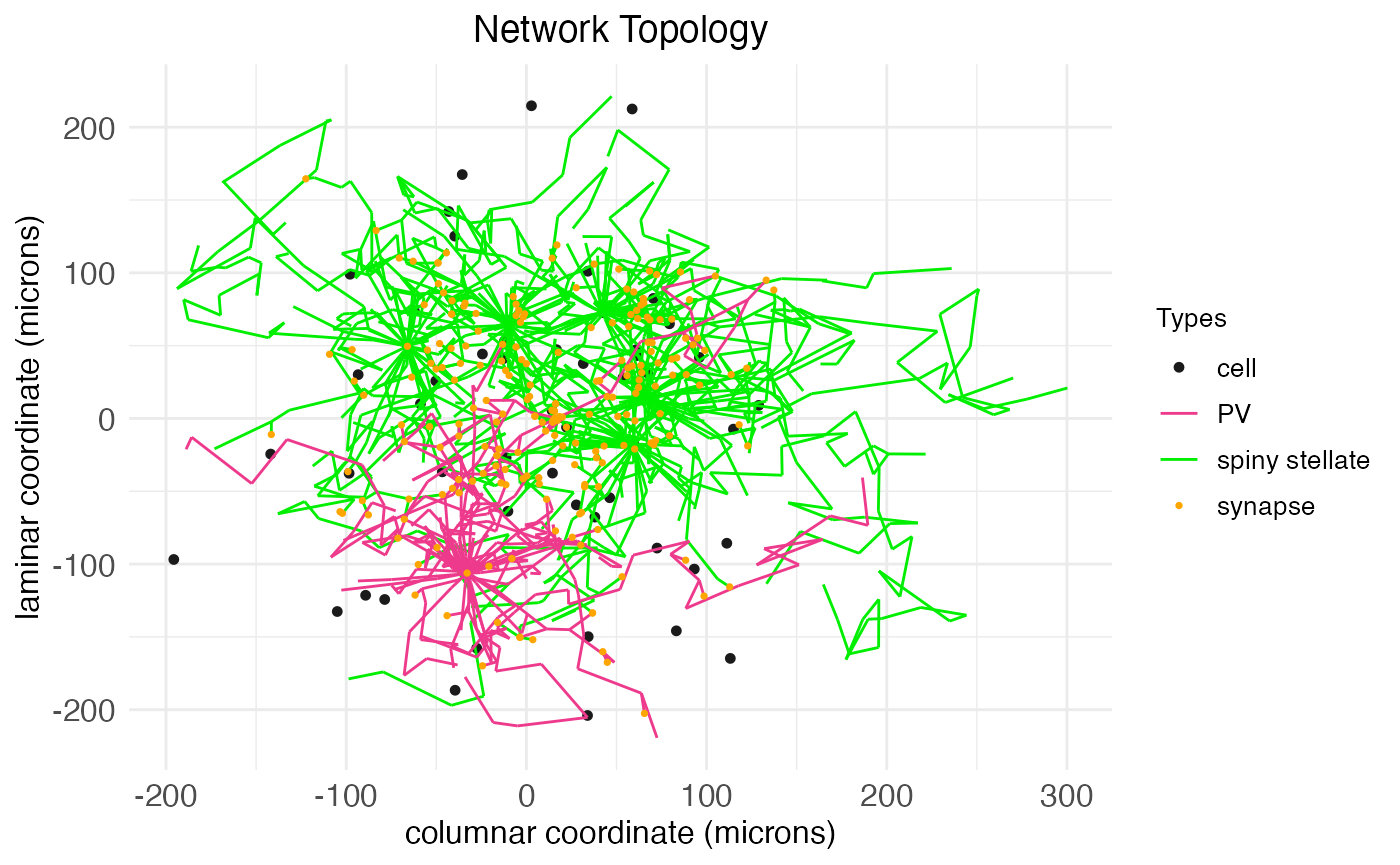
The arbors are generated via a biased random walk, the biasing factors fixed by cell type. The arbors include both axons and dendrites, which can be visualized explicitly by changing the arbor coloring. Although cells and arbors to-be-plotted are selected randomly, the plot.network function returns masks for the cells and arbors plotted, and can take this information to re-plot the same data again under different settings, e.g., coloring by arbor type instead of by cell type:
plt <- plot.network(
    network.node,
    arbor_density = 0.1,
    soma_mask     = plt$soma_mask,
    arbor_idx     = plt$arbor_idx,
    edge_color    = "is_axon"
  )
plt$plot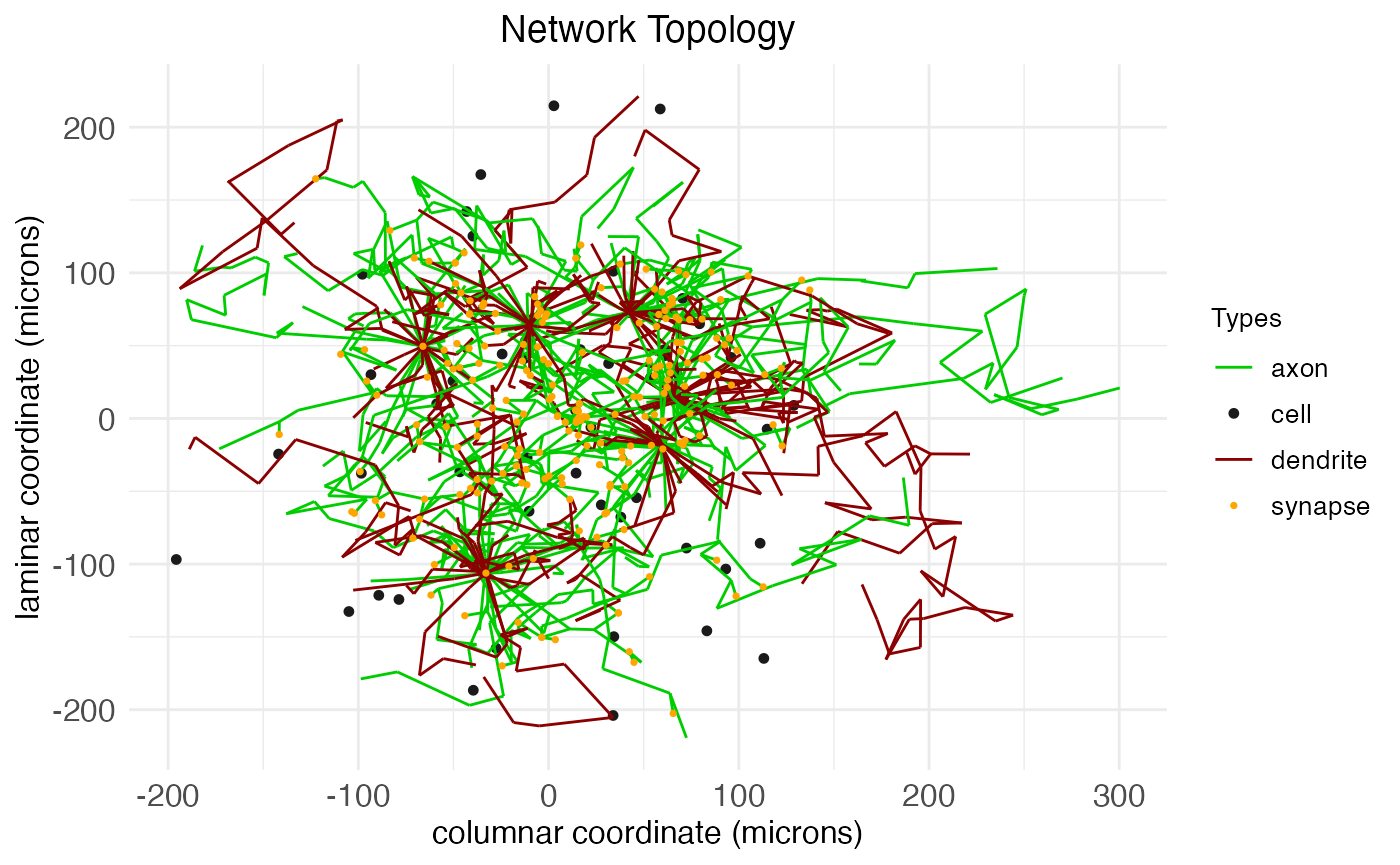
The existence and number of connections between cells – synapses, colored orange – are determined by the proximity of axons to dendrites. After the arbors are created, a separate algorithm looks for axon nodes within a certain small neighborhood (set by synaptic_neighborhood) of dendrite nodes and, if one is found, extends the axon to connect with the dendrite.
As the axis labels indicate, SGT models assign to each neuron a spatial coordinate giving its location along the laminar, columnar, and patch axes. All coordinates are continuous and real-valued and are used in conjunction with the transmission velocity parameter to simulate spike propagation over the axonal arbors. While the above are 2D plots (which drop the patch axis), we can plot a 3D representation of our node, colored by cell type:
plt <- plot.network(
    network.node,
    arbor_density = 1.0,
    soma_mask     = plt$soma_mask,
    arbor_idx     = plt$arbor_idx,
    threedim      = TRUE
  )
plt$plot
As can be seen, even for a small single node, the arborization and number of synapses can be extensive. We can quantify the extent by calling the fetch.network.components function, which returns a list of all components of the network, including a print out of summary data:
ntw <- fetch.network.components(network.node, include_arbors = TRUE)## Summary of network:
## Number of neurons: 55
## Number of synapses: 1655
## Hemisphere names: left
## Number of hemispheres: 1
## Subortical layer names:
## Number of subcortical layers: 0
## Cortical layer names: layer
## Number of cortical layers: 1
## Number of columns: 1
## Number of patches: 1
## Cell types used: spiny stellate, PV
## Motifs used: local connectionsAll of the above plots show the spatially extended arbors which produce synaptic connections between cells. If we want to visualize just the connections without the mess of the arbors, we can do so by setting reconstruct_arbors to FALSE. This represents connections between cells in the familiar form of straight edges. By plotting all arbors, we see that our network is more-or-less fully connected.
plot.network(
    network.node,
    arbor_density      = 1.0,
    reconstruct_arbors = FALSE
  )$plot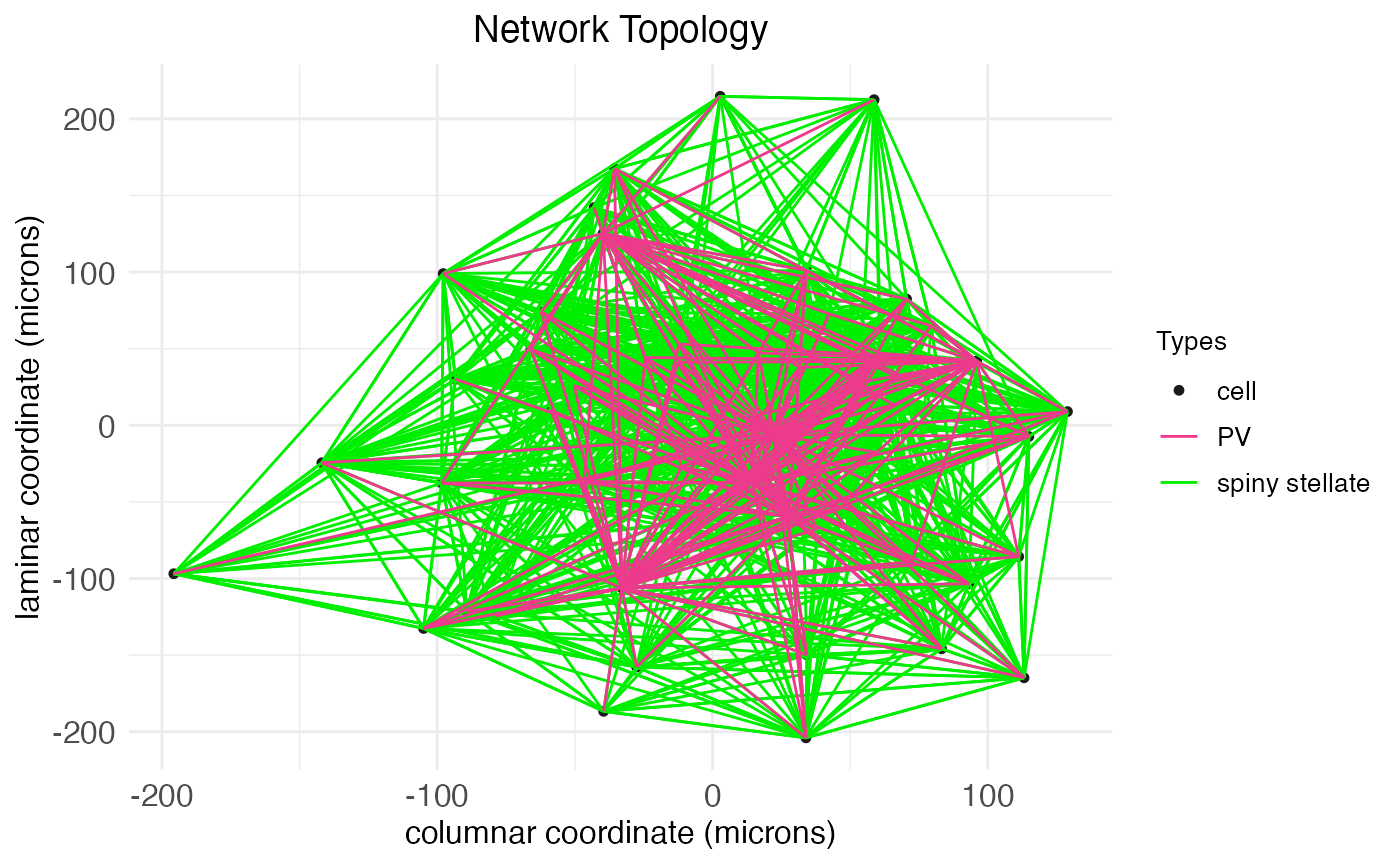
As the axis labels in the previous plots indicate, there is a physically meaningful unit attached to the dimensions: microns. The formulas used to compute spatial coordinates are discussed in the network-topology tutorial.
SGT simulations
The function run.SGT runs a simulation of spiking activity across a network using a SGT model. The function is just a wrapper over the SGT method of C++ network objects. It takes four arguments:
- network: A network created by the new.network function and structured by the set.network.structure function.
- I_stim: A matrix of input currents (in pA) over the duration of the simulation, rows representing neurons and columns representing time bins.
- dt: Time-step size for simulation, in ms. Default is 10^{-3}.
- initial_potential: Initial value for membrane potential, applied to all cells. Default is -70 mV, and this means that if any cell types in the network have a rest potential above -70 mV, this value must be changed.
The number of columns of I_stim determines the length of the simulation. In essence, the function run.SGT answers the question: How would the network respond to this stimulus current over this amount of time?
For example, let’s run a 1,200 ms simulation for the node we created above. From the above call to fetch.network.components, we know there are 71 neurons in our network. We can load this value directly from the function output:
n_neurons <- ntw$n_neuronsThis gives us the number of rows needed in our stimulus current matrix. For the number of columns, we need to know the number of time steps required:
stim_time_ms <- 1200
dt           <- 1e-3
n_steps      <- stim_time_ms/dt
cat("Number of time steps in the simulation:", n_steps)
## Number of time steps in the simulation: 1200000Now, suppose we want our simulation to have a 1000 ms input current to just the spiny stellates, starting at 100 ms. We can compute the initial and final time steps of this current, plus a mask for the spiny stellates, as follows:
# Set stimulus start and length
stim_length_ms      <- 1000
stim_start_ms       <- 100
# Find start and end steps of the input stimulus current
stim_length         <- stim_length_ms / dt
stim_start          <- stim_start_ms / dt
stim_end            <- stim_start + stim_length - 1
# Find mask for principal neurons
spiny_stellate_mask <- ntw$neuron_type_name == "spiny stellate"
A final question is how much current to apply. For this simulation, we’ll use a constant current of 100 pA to the spiny stellates during the stimulus period. As cell responses are fully deterministic, we will also feather the onset of this stimulus current, so that the initial spikes come at slightly different times.
I_stim <- matrix(0, nrow = n_neurons, ncol = n_steps)
I_stim[spiny_stellate_mask, stim_start:stim_end] <- 100
for (i in which(spiny_stellate_mask)) {
    I_stim[i, stim_start:(stim_start + sample.int(50/dt, 1))] <- 0
  }
With the stimulus current matrix in hand, we can run the simulation:
sim_results <- run.SGT(
    network.node,
    I_stim,
    dt
  )
The result of the function run.SGT is a matrix of spike traces formatted similar to I_stim: each row represents a neuron and each column represents a time step from the simulation. Each entry is the membrane potential of the neuron at that time bin, in mV. The order of neurons and time steps matches across the input stimulus-current and output spike-trace matrices, of course. In addition, a vector of spike counts for each neuron (giving the number of times each neuron spiked) in the network is also returned. Both are returned in a list of two elements, sim_traces and spike_counts.
The neurons package also includes the function plot.network.traces, which takes a network object with a trace matrix and produces a plot of the traces, putting all neurons of the same type together.
plot.network.traces(network.node, I_stim = I_stim, return_plot = TRUE)## Warning: Removed 172 rows containing missing values or values outside the scale range (`geom_line()`).
## Removed 172 rows containing missing values or values outside the scale range (`geom_line()`).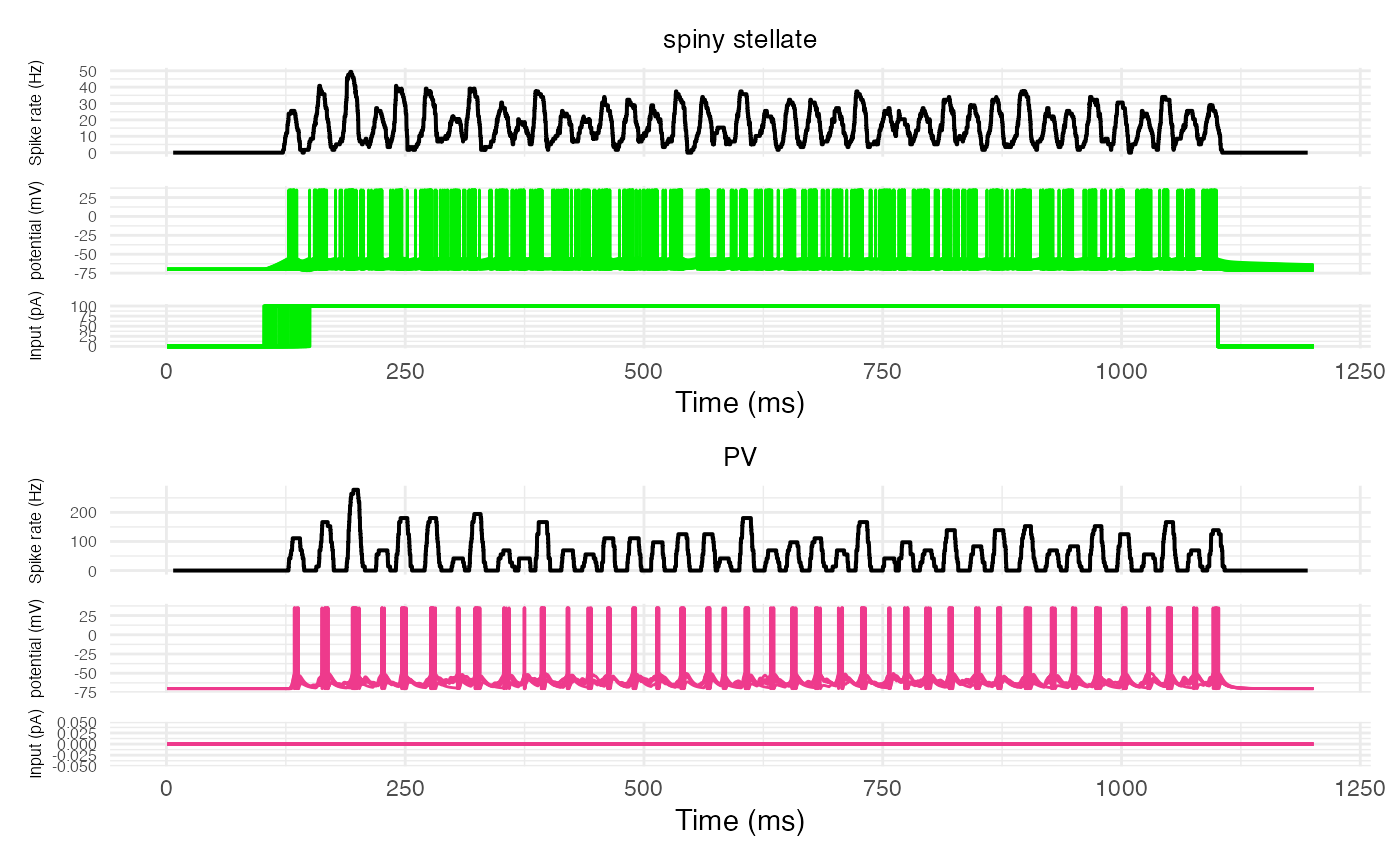
plt <- plot.network(
    network.node,
    arbor_density = 1.0,
    threedim      = TRUE
  )
plt$plot
At first glance, we see a rhythmic firing of the excitatory spiny stellates of about 4 Hz (i.e., theta waves, as in deep sleep). We see a matching rhythmic pattern for the PV cells. This is a classic excitatory-inhibitory feedback loop, wherein the excitatory cells drive the stimulus-free inhibitory cells to fire, the inhibitory firing silences the excitatory cells, which silences the inhibitory cells, allowing the stimulus current to the excitatory cells to drive them again, producing a new round of firing.
One way to see this dynamic is to rerun the simulation, first with no input into the PV cells, then with input into the PV cells, but no feedback onto the spiny stellates. Cell type information is saved across the session, so, we only need to modify the relevant part of the PV cells (the strength of the synapses from spiny stellates).
set.seed(12345)
network.node_disconnectedPV <- new.network()

# Disconnect PVs from spiny stellates
modify.cell.type(
    "PV",
    g_syn = list("spiny stellate" = 0.0)
  )

# Set network
network.node_disconnectedPV <- set.network.structure(
    network.node_disconnectedPV,
    neuron_types          = c("spiny stellate", "PV"),
    neurons_per_node      = c(n_ss, n_PV),
    synaptic_neighborhood = sn # microns
  )

# Rerun with PVs disconnected
sim_results_disconnectedPV <- run.SGT(
    network.node_disconnectedPV,
    I_stim,
    dt
  )

# Plot traces
plot.network.traces(network.node_disconnectedPV, I_stim = I_stim)
## Warning: Removed 164 rows containing missing values or values outside the scale range (`geom_line()`).
## Removed 164 rows containing missing values or values outside the scale range (`geom_line()`).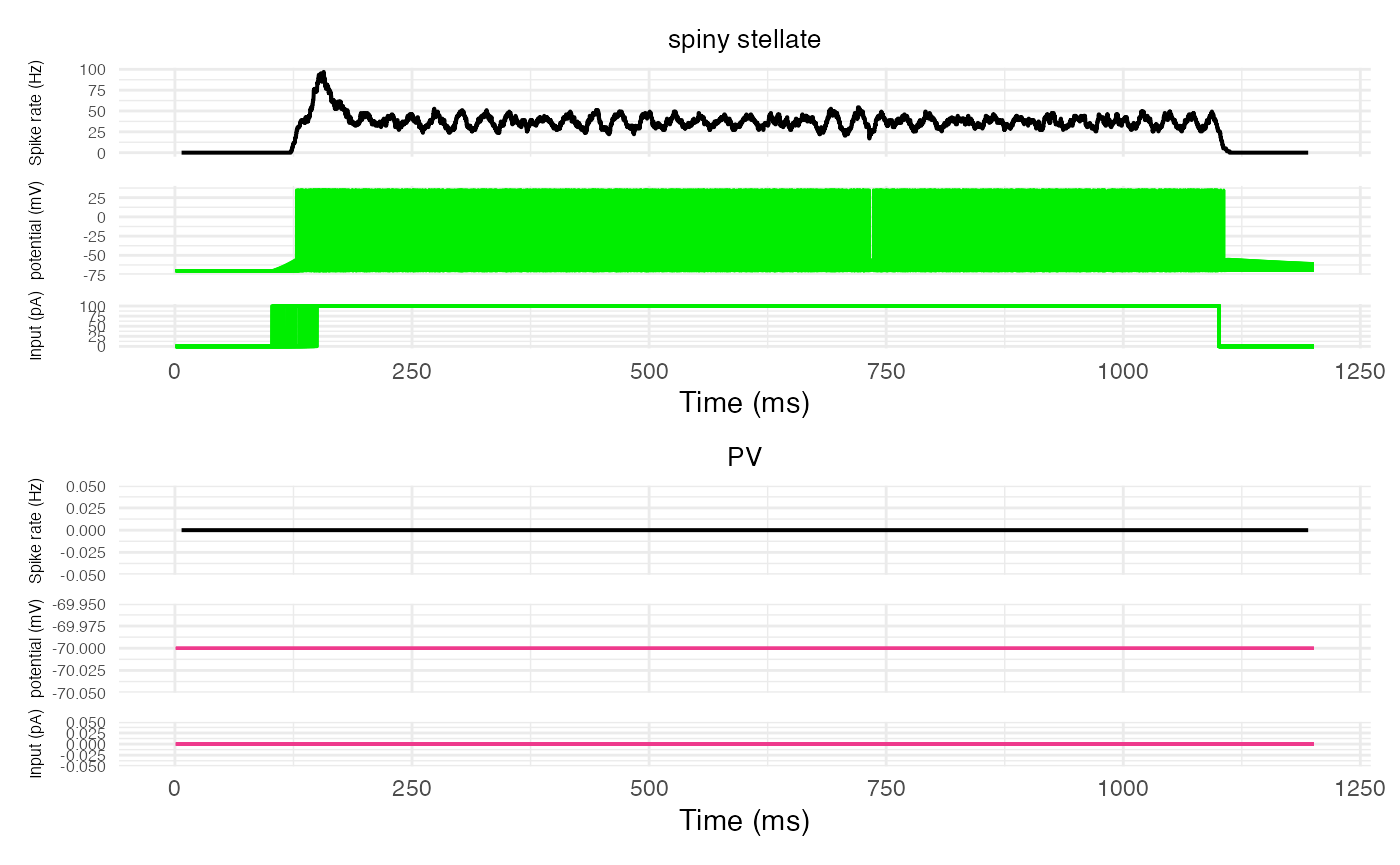
As can be seen, without spike input from the spiny stellates, the PV cells show no activity. Note, also, that without the inhibitory feedback from the PV cells, the spiny stellate population has lost its rhythmic firing. As there is a constant stimulus driving the cells, the population as a whole shows a constant firing.
Thus, the rhythmic firing pattern of the original network requires the excitatory-inhibitory feedback loop.
Spatial lag
What about I_\mathrm{synaptic\;transmission}, the input current induced by synaptic transmission across all synapses? We assume that the induced post-synaptic current is equal to the inducing pre-synaptic potential, modulated by the synaptic conduction. However, the complicating factor is that, given spatial distance between cells and synaptic transmission time, the relevant pre-synaptic potential v at time t from pre-synaptic neuron N may not be v(t), but rather v(t^\prime) for some t^\prime < t.
Let \vec{v} = \langle v_1, v_2, \ldots, v_n\rangle be the vector of membrane potentials for all n neurons in the network at time t. Further, let V be a n\times n time-dependent matrix which captures how each neuron “sees” the others. Specifically, V_{ij}(t) is the membrane potential of neuron N_i that reaches neuron N_j at time t. Then, assuming Q is an n\times n matrix of synaptic connections such that Q_{ij} is the conductance from neuron j to neuron i, we have that: I_\mathrm{synaptic\;transmission}(N_i) = \sum_{j=1}^n Q_{ij}V_{ji}(t)